- Fast Delivery Available!
- 211 Stirling Highway, Claremont, WA 6010
- 0412 561 620
- 0481 102 649
- Email Nicole
A pool cover roller lets one person take the blanket off and put it back on without dragging it across the paving. As a registered Daisy dealer in Claremont, we supply stationary, mobile, low profile, above ground and budget rollers, with delivery across Perth and WA. Send us your pool width and length and we’ll match the right size.
A roller makes a pool blanket quick enough to use every day. A blanket for a typical backyard pool is large, heavy and awkward to handle when wet. Without a roller it usually gets dragged across the paving or left folded on the lawn, and that is what shortens its life.
The best pool blanket is the one you actually use. If taking it off becomes a chore, it stays off, and you lose the water, heat and chemical savings you bought it for. That’s why we recommend choosing your roller at the same time as your pool blanket.
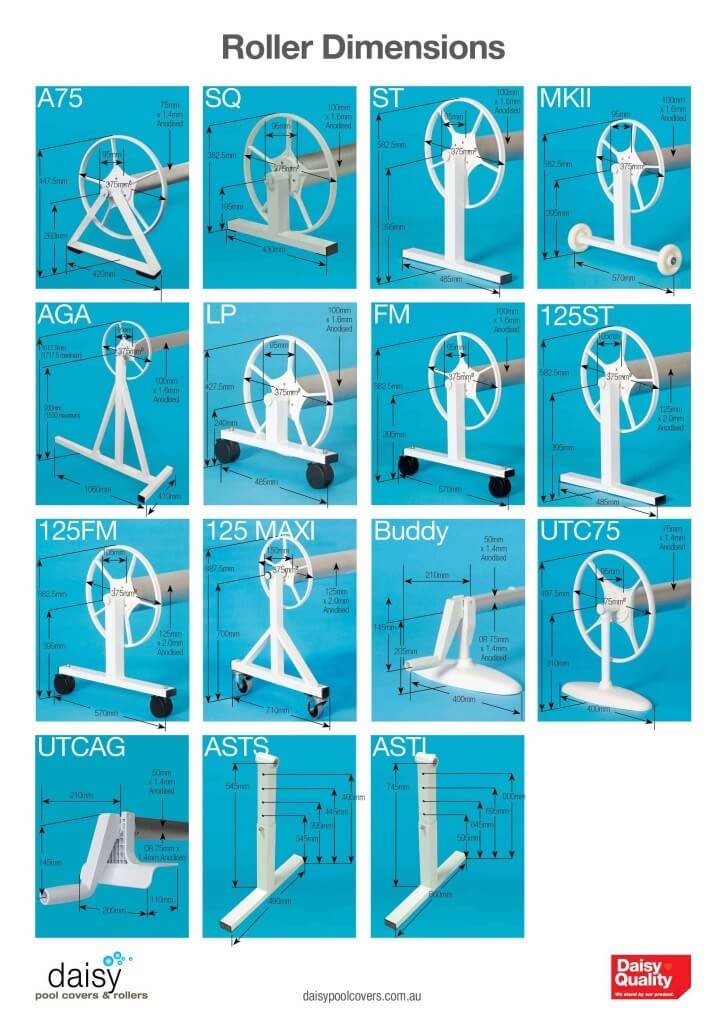
There are five main types in the Daisy range we stock. The right one depends on your pool, your paving and whether the roller needs to move.
The most common choice. A stationary roller sits on a frame at the end of the pool. It isn’t bolted down and can be lifted away when you need the space, but it is designed to stay in one spot. See the Daisy 5 Star A100 and A75 stationary rollers.
Fitted with wheels so you can move the roller and rolled-up blanket away from the pool in any direction. A good fit if you entertain around the pool or need the end clear for access. See the Daisy 5 Star FM.
Mobile rollers that sit lower to the ground, for tighter paving or where you want the roller less visible. See the Daisy 5 Star LP.
Adjustable-height rollers designed to sit alongside an above ground pool. See the Daisy 5 Star AGA.
A simpler, lower-cost option for smaller pools. See the Daisy UTC Buddy.
Every Daisy roller comes with a white over-cover to protect the rolled-up blanket, and a kit to connect the blanket to the roller.
Five questions narrow it down:
Not sure? Send us your pool measurements and a photo, or bring them into our Claremont store, and we’ll recommend one.
The roller tube should be about 300 mm wider than the main pool area, so it sits around 150 mm past each side. For example, the Daisy 5 Star A100 suits pools up to 4.6 m wide and up to 12 m long, with a tube of around 4.9 m.
Length matters too. A longer pool means more blanket on the tube, so longer pools need a larger roller. Many Daisy rollers have an adjustable tube that is cut to length on site. Send us your pool width and length and we’ll work out the right size. Our measuring guide shows you how.
Put the roller at the opposite end to any steps or swim-outs, usually the deep end. That way the step area can be folded in before rolling, instead of making a thick, uneven roll.
Centre it across the end of the pool, with enough room to walk around it and turn the handle. On a free-form or kidney-shaped pool, use the straightest end.
Yes. Domestic rollers are designed for one person. You turn the handwheel to roll the blanket on, and pull the blanket back out across the pool to cover it.
In most cases, yes. If the blanket is in reasonable condition it can be attached to a new roller with a connection kit, as long as the roller is the right width for your pool. If the blanket is old and brittle, it’s usually worth replacing both together.
Yes, if the roller is in good condition: the tube isn’t bent, it turns freely and it’s the right width. You’ll need a refit kit to attach the new blanket. If the over-cover is worn or faded, replace that too.
Eyelets are fitted along the end of the blanket, a short way in from the edge. Cords or straps run from each eyelet to the roller tube and are adjusted so the blanket rolls on evenly and square to the pool.
Yes. Mobile and low profile rollers wheel away. Stationary rollers aren’t bolted down either and can be lifted away when needed.
Yes. The roller is sized to the widest part of the main pool area and the blanket is trimmed to your pool’s shape. Position the roller at the straightest end so the blanket rolls on evenly.
Allow room at the end of the pool for the frame, the rolled-up blanket and enough space to walk around it and turn the handle. If space is tight, a low profile roller sits lower and takes up less room.
Daisy rollers are made in Australia from powder coated aluminium with stainless steel fittings, which don’t rust the way ordinary steel does. Hosing off salt and chlorine now and then helps, especially near the coast.
Put the white over-cover on whenever the blanket is rolled up, even for a short swim. Direct sun on a rolled-up blanket can damage it quickly.
A well looked after roller will usually outlast several blankets. Avoid sitting or standing on the tube, as a bent tube cannot be repaired. Lock the castors on mobile rollers when in use.
Yes. Many Daisy rollers come with an adjustable tube you cut to length, complete with the required drill bit and instructions. It’s a straightforward job for most handy people. If you’d rather not, we can quote for Daisy installation of the roller and blanket.
For most pools, yes. A blanket folded on the lawn isn’t saving any water, heat or chemicals. A roller makes the blanket quick to use, so it gets used every day, and keeps it protected under the over-cover instead of being dragged across paving.
Daisy recommends that your roller tube be at least 300mm longer than the widest part of the blanket you’re rolling up. Need help with sizing? Just email us your details and we’ll calculate it for you.
Browse the rollers, see our Daisy pool blankets, or get a quote on a blanket and roller together. Email us from our website, or use our calculator online and we’ll deliver across Perth and WA.
"*" indicates required fields
"*" indicates required fields
"*" indicates required fields